







A business can spend months getting its website, search and adverts to the point where enquiries arrive regularly, and then lose a share of them in the part nobody designs: the reply. The enquiry sits in an inbox overnight, the first response is a generic acknowledgement, and by the time a real answer goes out the customer has booked someone else.
This is the least glamorous part of marketing and one of the most dependable. It needs three things: a fast reply, a useful one, and a clear line between following up an enquiry and adding someone to your marketing.
The key idea
Reply fast, reply usefully, and keep follow-up about the enquiry. Marketing is a separate permission, not a reward for having asked a question.
The first hour matters more than the fifth email
The best-known research on response time is old, American and still instructive. In 2011, Harvard Business Review published an audit of 2,241 US companies’ responses to web enquiries. Only 37% responded within an hour, and among firms that responded within 30 days the average response time was 42 hours. In a separate analysis of 1.25 million leads at 42 US companies, firms that tried to contact a potential customer within an hour were nearly seven times as likely to qualify the lead as those that waited even an hour longer.
Your market is not the same as the one in that study, and the exact multiples will not carry over. The direction almost certainly does. Someone who has just filled in a form is at their most interested and most available at that moment. Every hour after that, they are doing something else, or asking someone else.
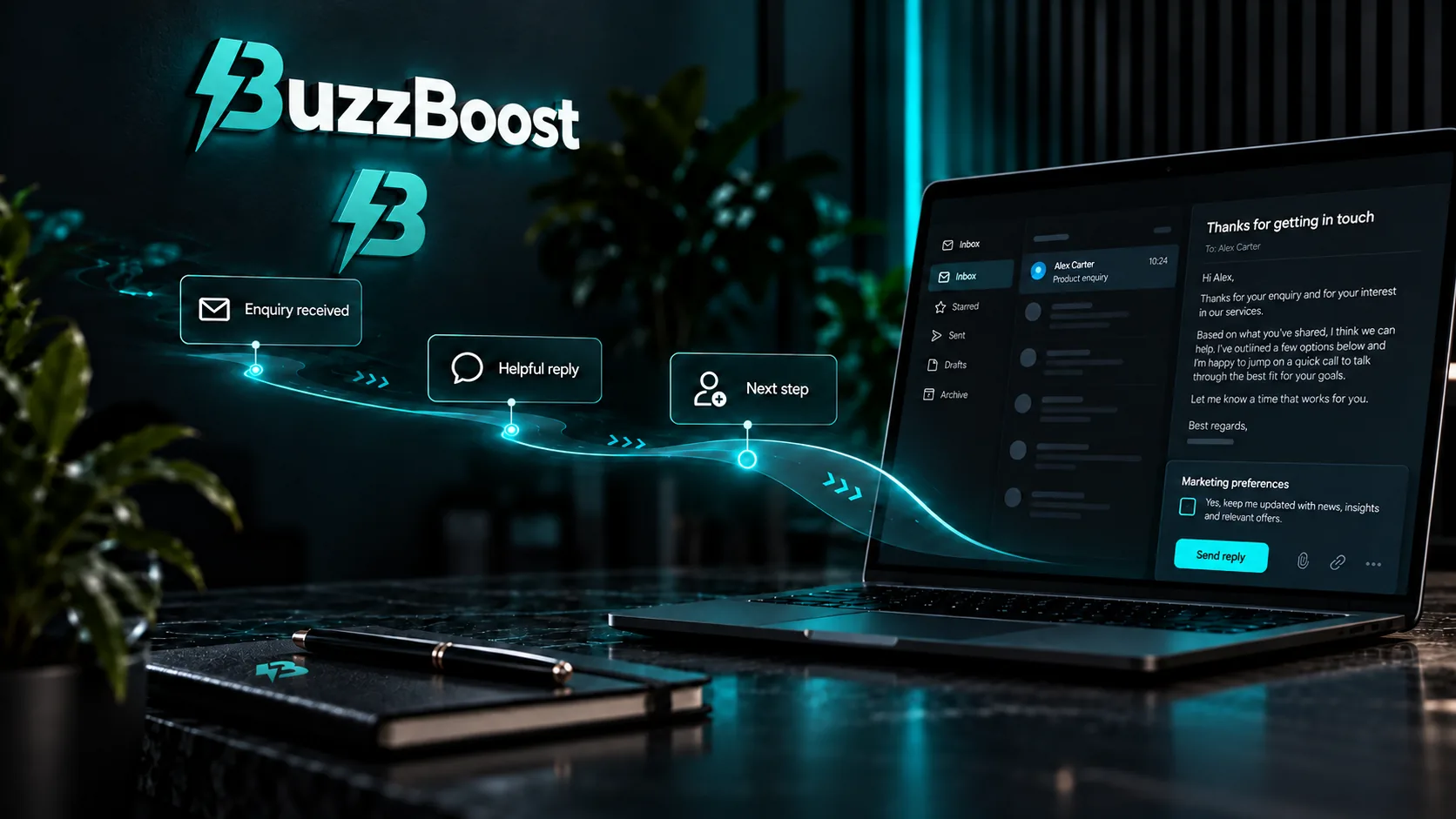
In practice that means two replies, not one. An automatic acknowledgement the moment the form is sent, saying you have it and when a person will reply. Then a real reply from a person within working hours, ideally the same morning or afternoon.
What a useful first reply contains
A fast reply that says nothing is only slightly better than a slow one. The first real reply should do five things:
- Show you have read the enquiry, in a sentence that could only have been written to them.
- Answer the question they actually asked, even if the full answer needs a call.
- Offer one clear next step with a time attached: a call slot, a visit, a quote by a date.
- Ask only for what you need to take that step.
- Come from a named person they can reply to.
For example, a reply to someone asking about a new website might confirm what they said the current site is struggling with, give a realistic sense of how projects like theirs are usually priced, offer two times for a twenty-minute call this week, and ask for a link to the current site. That is a reply they can say yes to.
Follow-up that does not nag
Some enquiries go quiet after the first reply. A short, planned follow-up is reasonable and often welcome, because people get busy rather than lose interest. A simple pattern works for most service businesses: a friendly check two or three working days after the first reply, and a final note about a week later saying you will close the enquiry unless they want to pick it up. Then stop.
Each follow-up should still be about their enquiry: the quote, the call, the question they asked. Once the messages start promoting other things, they are no longer follow-up, and different rules apply.
Where follow-up becomes marketing
In the UK, email marketing to individuals is governed by the Privacy and Electronic Communications Regulations (PECR) as well as data protection law. The ICO draws a useful line: messages sent purely for administrative or customer service purposes, service messages, do not count as direct marketing if they only give administrative information and do not promote anything. Replying to an enquiry, and following up that enquiry, sits on that side of the line.
Adding the enquirer to your newsletter is different. For individuals, which in PECR includes sole traders and ordinary partnerships, you need their consent, or you need the conditions of the “soft opt-in” to be met. The ICO sets those out: you collected their details during a sale, or negotiations for a sale; you are marketing your own similar products or services; and you gave them a clear, simple way to opt out when you collected their details, and in every message after that.
The practical point is at the form. If you might ever want to send marketing to people who enquire, the chance to say no has to be there when you collect their details, not added later. And the soft opt-in does not apply to bought-in lists or new contacts. Emailing limited companies and other corporate bodies is treated differently, but it is still good practice to keep a do-not-email list for any that object.
Make sure the replies arrive
A good reply is no use in a spam folder. From February 2024, Gmail began requiring anyone sending more than 5,000 messages a day to Gmail addresses to authenticate their email, offer one-click unsubscribe from commercial email and process it within two days, and stay under a spam complaint threshold. Most small businesses send far fewer messages than that, but the same authentication records on your domain help ordinary replies get delivered too, and they are worth setting up properly once.
Put it in one place
All of this is easier when every enquiry lands in one place with a status: new, replied, followed up, won, closed. A CRM does not need to be elaborate to do that. What matters is that nobody has to remember which enquiries are waiting, and that you can see how long replies are actually taking rather than how long you think they take.
Check your own follow-up this week
Where to start
- Send an enquiry through your own website. How long did the acknowledgement take, and what did it promise?
- Look at your last ten enquiries. How long did the first real reply take, measured in hours, not days?
- Read your last three first replies. Would they pass the five-point test above?
- Check your form. If you add enquirers to marketing, is there a clear way to say no at the point of collection, and an unsubscribe in every marketing email?
- Ask whoever manages your domain whether email authentication is set up.
This is general information about PECR, not legal advice. The ICO’s guidance, linked below, is the authority on how the rules apply to your situation.
The enquiry is the start of a conversation. Treat the reply as part of the product.
Where this fits
Enquiry handling is where email and CRM work earns its keep: acknowledgements, reminders and a clear record of every conversation. The acknowledgement step itself is covered in small automations that reduce everyday admin, and if you want AI to help draft replies, AI and workflow automation can do that with a person still in charge.
If enquiries are arriving but not turning into work, we can look at how they are acknowledged, answered and followed up, and set the process up in your CRM.
Sources
- Harvard Business Review: The Short Life of Online Sales Leads (Oldroyd, McElheran and Elkington, March 2011)
- ICO: key concepts for direct marketing using electronic mail
- ICO: the rules on direct marketing using electronic mail
- ICO: electronic mail marketing (guide to PECR)
- Google: Gmail sender requirements announcement (2024)